
Welcome to Widow Creek Railroad
SMALLER. SMARTER. INTERACTIVE.
Building a railroad that listens, responds, and engages the operator.
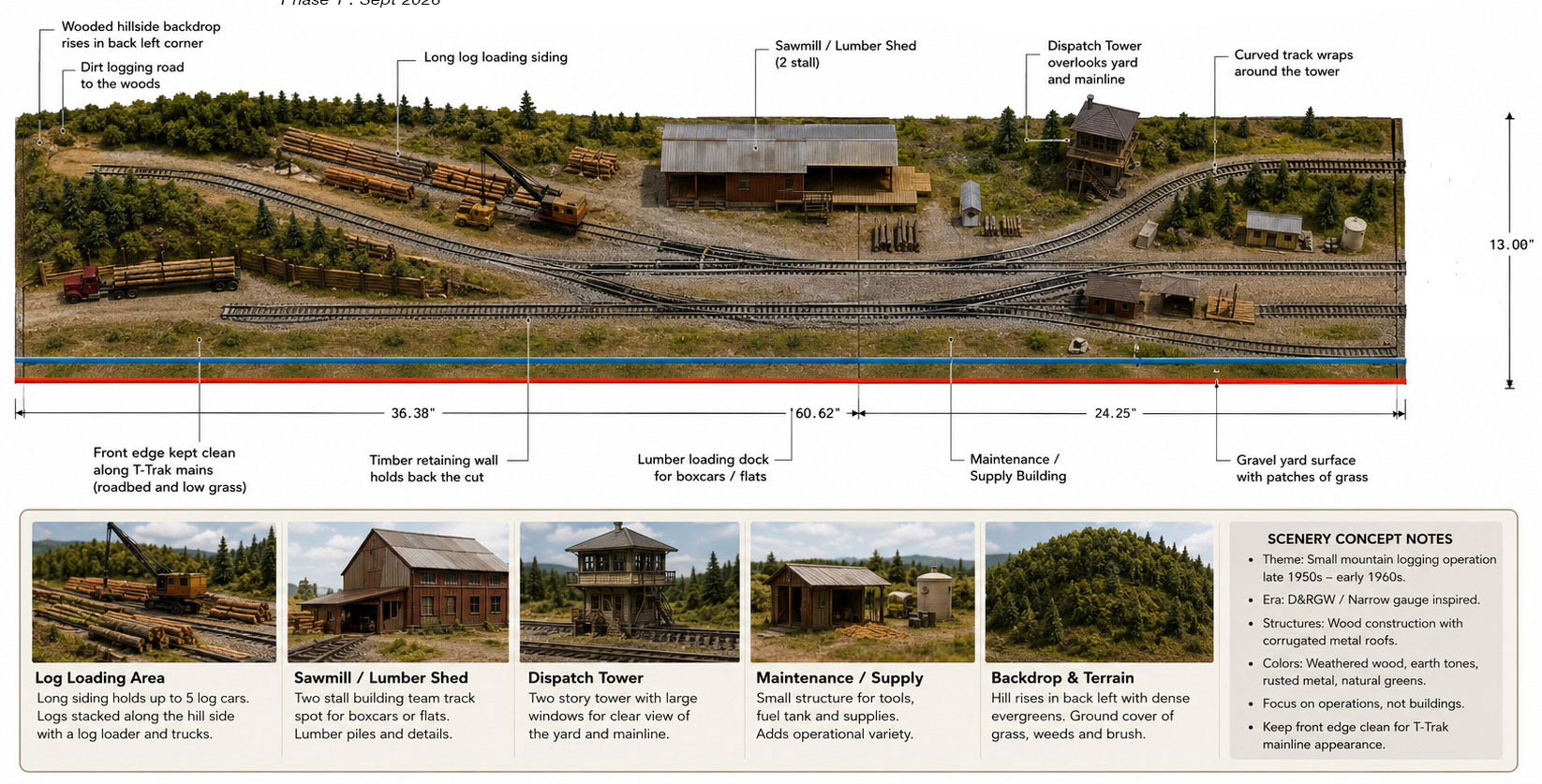
Widow Creek Railroad is currently centered on Creekside Timber & Milling, a 7 foot by 1 foot N scale switching railroad inspired by the Denver & Rio Grande and the rugged high country around Marshall Pass, Colorado. The compact footprint gives me more room in less physical space for meaningful switching operations while still preserving the challenge of the puzzle, and provides a practical platform for building, testing, and expanding the ideas behind Widow Creek.
Creekside is designed around switching, interaction, and operation rather than simply watching trains run. It is small enough to build now, flexible enough to expand, and large enough to create meaningful railroad problems for the person holding the throttle.
At the heart of that work are RAILS, the Railroad Awareness, Intelligence & Logistics System, and IRROD, the Interactive Railroad Operations Dispatcher. Detection, identification, sound, lighting, switching, sensors, communications, and other electronics are being developed as modular systems that can work across different layouts, scales, and operating environments.

Widow Creek is about building smarter, more interactive railroad experiences in the space available now, using modern tools, electronics, software, modular construction, and practical experimentation.
The railroad may be compact, but what happens on it won’t be.
Click to Listen
On the Workbench
Creekside Timber & Milling
84″ x 13″ T-Track Switching Module (N Scale)

Current Blog Posts
Narrowing the Focus
I started by creating a track plan that balances real operations and space efficiency using T-Trak Modules I’m laser cutting myself.

MRR Speedometer (Arduino)
An Arduino-powered model railroad speedometer uses two infrared sensors to measure a locomotive’s scale speed in either direction, helping with realistic operation and DCC speed matching.

Chronology of America’s Freight Railroads
In an era of interstate highways and quick air travel, it is difficult to imagine just how isolated those parts of the United States farthest from the oceans were, even as late as the mid-19th century.
General Documents
Photos from the D&RGW


The Dispatcher
Tell us your thoughts, and ideas, or just say "Hi."
If you would like to share your Arduino ideas I am very active with the system
I lost my layout due to down sizing but I am still writing code to finish some of the projects I have developed
I was wondering when you were going to get back into the Arduino projects. It seems like most model railroaders have abandoned the idea, but I’m excited to see where you go with these.
Joseph, that was actually a big part of the reason for scaling everything down. The switching layout gives me a much better place to develop and test the Arduino projects without trying to build an entire railroad around them. I’ve got several of the older projects coming back to the workbench, along with some new ideas I’ve wanted to experiment with for a long time. I think this smaller layout is going to let me do a lot more with the electronics than I ever did with the larger railroad.
I have not considered a modular for a more permanent layout. I love the idea, and my husband and I are rethinking our plans for our basement. Where did you get the corner clamps?
I’m in a rental and also chose the modular benchwork. It’s much easier to relocate when we buy.
They are on Amazon ( https://amzn.to/3mvKcJg ) and are $28 for a pair or $55 for all 4. I have built many different tables and modules, and these clamps are the best way to get a true corner, especially when working alone.
probably the best website I have seen on a model railroad
Thank you!
Long time since I have seen your name around. Back in your Colorado Springs days. Glad you’re still active.
Happy to meet you at Plano train show! Looking forward to you coming by
Texarkana in the summer to see the progress on my 8X16 layout.
Always cool meeting new modelers. How’s your layout coming, have you started yet?
I tried this same Smart Dimmer last year and could not get it to connect with Google Assistant. It works with the Smart Life App only.
Right now, I am working with SmartLife on trying to figure this out. They advertise that this dimmer is Alexa and Google controllable. Alexa sees the device through the SmartLife Skill but reports “Device Unresponsive.” In my last email this morning, SmartLife stated:
I am still determining what a Bluetooth Gateway is, but I am looking into it.
Well, the Smart dimmer, while it does work with the App by itself, it does NOT work with the Virtual assistants as advertised. You need a Wireless Bluetooth Gate device to get it to work. The smart dimmer is a Bluetooth-only device, and something else needs to be the “go-between.” I found a Moes Wireless Smart Gateway ( https://amzn.to/3yvrlAP ) on Amazon that did the trick! Luckily the Moes were in the US, and I didn’t have to wait months; unluckily, there were no directions. But it didn’t take me long to figure it out. If you need help, email me.