January 10, 1943: Rock Island No. 750 leads Train No. 8, the Rocky Mountain Rocket, east of Colorado Springs on January 10, 1943, with Pikes Peak dominating the background. The three car train was recorded traveling at 35 mph.
A Railroad Connection I Wasn’t Expecting
Over the last several weeks, I’ve been doing a lot of railroad research for Widow Creek’s Creekside Timber layout, and as often happens, that research took me someplace I wasn’t planning to go. This particular trail started when I began looking a little more closely at the Chicago, Rock Island & Pacific. Living in Arkansas, there’s plenty of Rock Island history around me, and several members of our local model railroad club know that history considerably better than I do.
My railroad, however, isn’t in Arkansas. Widow Creek Railroad and Creekside Timber & Milling are firmly planted in Colorado. The Denver & Rio Grande is my home railroad, and Creekside is based around the Marshall Pass area. I wasn’t looking for a reason to change any of that. I was simply curious whether there was enough of a historical connection between Rock Island and Colorado to occasionally bring some of that Arkansas railroad history into the world I’ve been building.
I figured we’d probably find evidence of freight interchange. What I didn’t expect was to find Rock Island woven into Colorado railroad history for decades.
Rock Island Really Did Go to Colorado
Rock Island’s Colorado story reaches back into the late 1800s. By 1889, the railroad had reached Colorado Springs and established connections with the Denver & Rio Grande. More interestingly, the relationship went well beyond simply handing freight cars from one railroad to another. Rock Island trains actually operated over Rio Grande rails.
The arrangement eventually became the subject of litigation, leaving behind a remarkably detailed historical record. An 1892 U.S. Supreme Court decision describes an agreement dating to 1888 that gave the Rock Island predecessor use of Rio Grande tracks, stations, sidings and switches between Colorado Springs and Denver, along with terminal facilities in Denver. After the connection at Colorado Springs was completed, Rock Island trains used the Rio Grande route to reach Denver and Pueblo.

Rock Island F7A Nos. 114 and 127 and GP18 No. 1334 share Denver’s North Yard with D&RGW F7A No. 5604 on March 30, 1966. A perfect example of Rock Island and Rio Grande equipment occupying the same Colorado railroad yard.
Rock Island later gained a shorter route into Denver using Union Pacific tracks from Limon, so most Denver traffic eventually shifted that way. The Colorado Springs connection remained important, however, and Rock Island continued using its Rio Grande connection for Pueblo traffic.
At that point, this little research project was already getting more interesting than I expected. Then I started going through the photographs.
A Rock Island Pacific in Colorado Springs
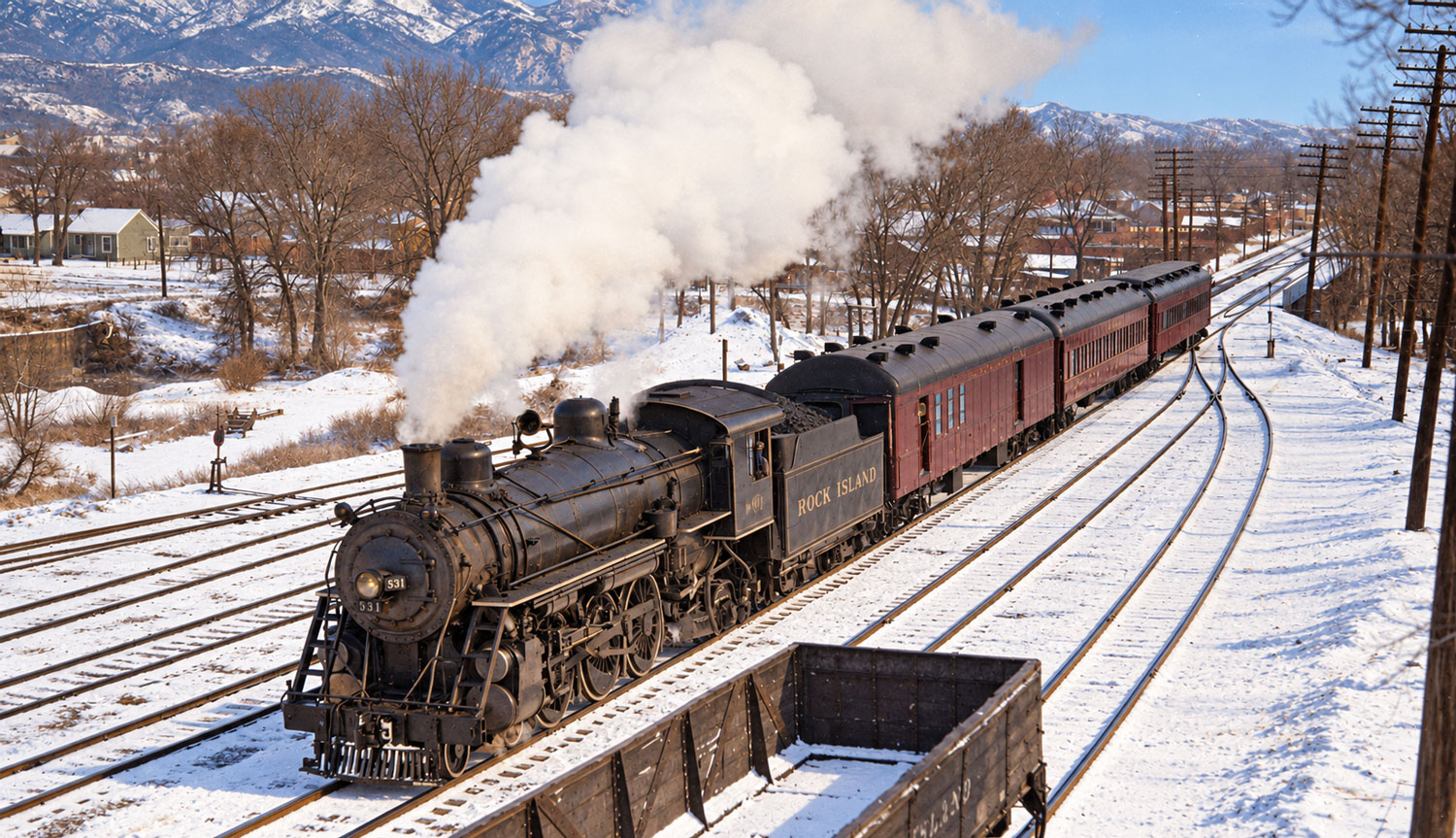
Chicago, Rock Island & Pacific No. 891 arrives in Colorado Springs with Train No. 5, the Colorado Express, on March 8, 1931. The three car train was recorded traveling at 25 mph.
One of the photographs I found in the Denver Public Library’s Western History collection shows Chicago, Rock Island & Pacific No. 891, a 4-6-2 Pacific, arriving in Colorado Springs on March 8, 1931. It’s pulling Train No. 5, the Colorado Express, and according to the information preserved with the photograph, the three car train was moving at 25 mph.
There’s something about actually seeing the photograph that makes the history more real than finding Colorado Springs on an old railroad map. There’s a Rock Island steam locomotive coming into Colorado Springs with its passenger train, snow covering the ground and the Colorado landscape behind it. We’re not looking at a freight car that wandered onto another railroad through interchange. We’re looking at a Rock Island train operating in Colorado.
Then I Found the Ford
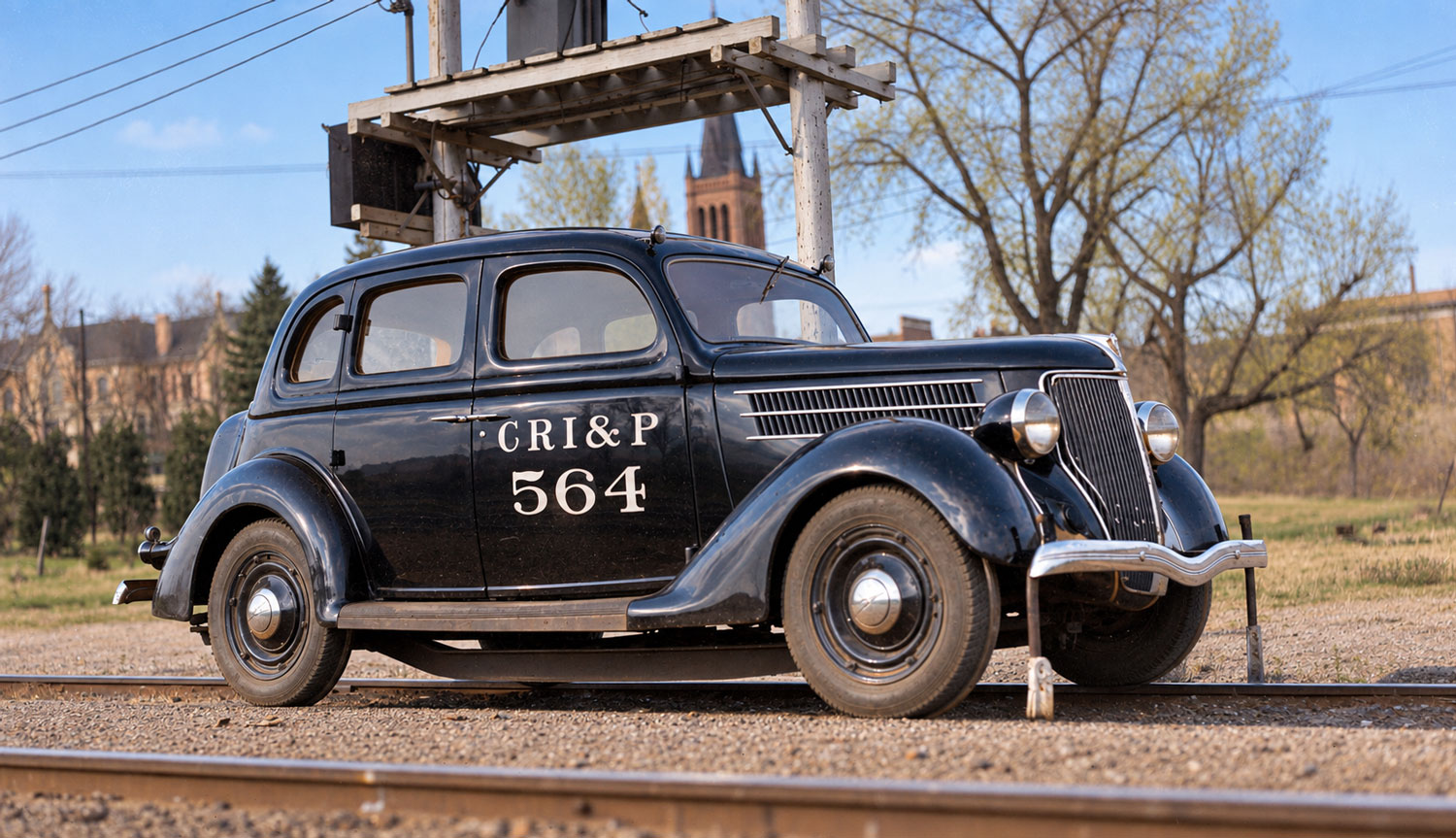
CRI&P No. 564, a Ford V-8 rail inspection sedan, photographed in Colorado Springs on May 9, 1938. It’s an interesting glimpse at the company equipment behind everyday Rock Island operations in Colorado.
The next photograph may be my favorite, and it isn’t even a locomotive. CRI&P No. 564 was a Ford V-8 sedan converted into a rail inspection car, photographed in Colorado Springs on May 9, 1938. It has railroad wheels underneath it and CRI&P 564 painted prominently across the door.
I like this photograph because it shows a different side of Rock Island’s presence in Colorado. Passenger and freight trains are what we normally think about, but here is ordinary company equipment being used for railroad work in Colorado Springs. It’s the kind of strange little piece of equipment that makes railroad history interesting. Everybody expects locomotives, boxcars and cabooses. A 1930s Ford sitting on railroad wheels makes you stop and look twice.
Naturally, being a model railroader, it didn’t take long before I started wondering how difficult one would be to build in N scale.
By the 1950s, Steam Was Giving Way to Diesels
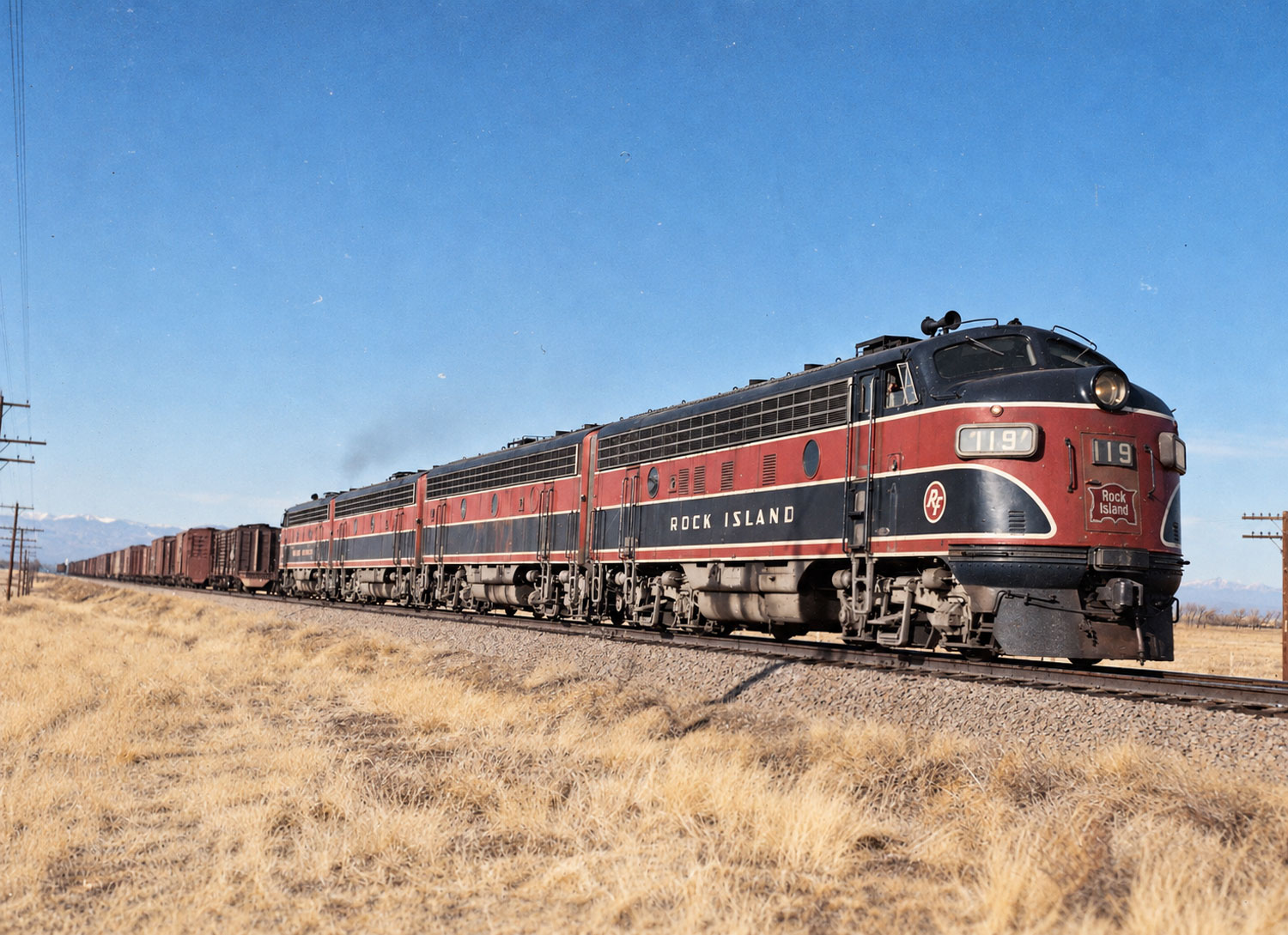
Rock Island diesel No. 119 leads an eastbound freight near Sky Ranch Airport in Adams County, Colorado, on January 3, 1954. A handwritten note on the original print identifies the railroad location as near Magee Station.
The photographs eventually brought me closer to the period I’m modeling. On January 3, 1954, Rock Island diesel No. 119 was photographed leading an eastbound freight near Sky Ranch Airport in Adams County, Colorado, with a long string of boxcars stretching out behind the locomotives.
There is a neat little bit of history preserved on the back of the original photograph as well. Someone penciled in that the railroad location was near Magee Station, and the photographer recorded his camera settings and the Kodak Super XX film used for the photograph.
What I like most about this picture is how ordinary it is. There’s no special event taking place. It’s simply a Rock Island freight moving through Colorado on a winter day. Put it beside the earlier photographs and we’re beginning to see a much bigger picture. We have a passenger train in 1931, company inspection equipment in 1938 and regular freight operations in 1954.
Then Came the Flood of 1965
This is where the story comes directly back to the Denver & Rio Grande. In June 1965, catastrophic flooding along the South Platte and its tributaries damaged railroad lines, yards, bridges and industrial areas around Denver. Photographs taken on June 17 show just how badly the railroad network was affected.

Flooding along the South Platte River in Denver on June 17, 1965. The flooded railroad complex includes the Colorado & Southern shops and other facilities south of the 14th Street Viaduct, with Santa Fe and Denver & Rio Grande Western main lines visible toward the upper portion of the photograph.
One aerial photograph looks across the railroad yards south of Denver’s 14th Street Viaduct. The Colorado & Southern shops and other facilities are surrounded by water, while the Santa Fe and Denver & Rio Grande Western main lines curve through the upper portion of the scene. Freight cars sit on isolated pieces of track, buildings are surrounded by water, and debris has been scattered throughout the railroad property.

Denver’s railroad district during the South Platte River flood on June 17, 1965. The 23rd Street Viaduct crosses the scene, with Chicago, Burlington & Quincy roundhouse, diesel shop and coach yard facilities beyond it. The original photograph notes point out the flooded turntable pit and partially submerged vehicles.
Another aerial photograph taken the same day looks across the 23rd Street Viaduct toward the Chicago, Burlington & Quincy facilities. The Burlington roundhouse, diesel shop and coach yards are visible beyond the viaduct, while floodwater covers portions of the surrounding railroad and industrial property.
The notes preserved with this photograph add some wonderful details. A long freight had just emerged from Burlington’s 38th Street Yard, crossed the South Platte River and was curving back across the river toward the Colorado & Southern main line. The flooded turntable pit and partially submerged automobiles and buses give you some idea of what railroad crews were dealing with.
Looking at these two photographs together, you realize this wasn’t simply a washed out siding or some standing water in a yard. A major railroad center had been disrupted, and multiple railroads were trying to keep trains moving through a transportation network that suddenly wasn’t working the way it was supposed to.
Rock Island Returns to Rio Grande Rails
One of the routes knocked out by the flooding was the Union Pacific line east of Denver. That mattered to Rock Island because it depended on the UP route between Denver and Limon for its normal Denver operation. With that route unavailable, the trains needed another way through.
The Rocky Mountain Railroad Club documented what happened next in its July 1965 newsletter. Rock Island locomotives and trains began operating over the D&RGW main line, something the club noted had not happened since the earlier joint trackage arrangement ended in 1938.
Rock Island wasn’t alone. The same contemporary account describes Rio Grande tracks around Denver carrying C&S, Burlington, Missouri Pacific and Rock Island traffic in addition to Rio Grande’s own trains. The disruption lasted far longer than a few days. According to a later club report, Union Pacific’s route between Denver and Kansas City did not reopen until August 10. Rock Island could then resume its normal direct operation between Limon and Denver after weeks of detouring through Colorado Springs and Palmer Lake.
That makes the flood photographs more than dramatic pictures of a natural disaster. We’re looking at the reason normal railroad operations throughout the region had to be rewritten. For part of the summer of 1965, Rock Island locomotives and trains were once again running over Rio Grande rails because that’s what it took to keep the traffic moving.
Rock Island and Rio Grande Together in Denver
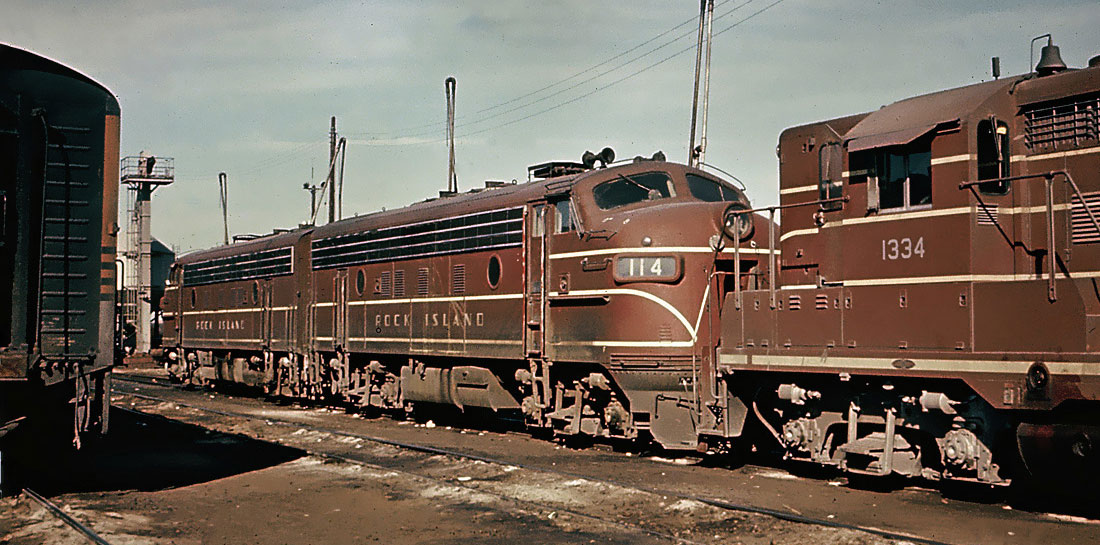
For me, that’s particularly interesting because we’re now standing almost exactly in the period represented by Creekside. These aren’t locomotives separated by decades and connected only through some complicated historical possibility. Rock Island and Rio Grande locomotives were sharing the same Denver yard.
By this point, the question that started the whole search had been answered. I don’t have to force Rock Island equipment into the Colorado railroad world surrounding Creekside. It was already there.
Which Brings Us Back to Creekside
Creekside Timber & Milling is fictional, and that’s intentional. I enjoy having the freedom to create its history, but I also like building that history around things that could reasonably have happened. Creekside has existed in my fictional history since 1864, while the layout itself lives generally around the 1964 period. I’m not trying to freeze everything to one particular date.
 I’ve always imagined Creekside as a successful company that takes care of its equipment. Something old doesn’t automatically get scrapped because something newer comes along. Equipment can be rebuilt, repurposed or purchased secondhand when it still has a useful job to do.
The Rock Island connection fits comfortably into that world. A Rock Island freight car arriving at Creekside doesn’t require an elaborate explanation because the real railroads interchanged freight and Rock Island was operating in Colorado. Even an older Rock Island locomotive eventually finding its way into Creekside ownership isn’t difficult to imagine. Railroads sold locomotives, industrial operations bought secondhand equipment, and Creekside has a century of fictional history in which something like that could have happened.
And after finding that Ford V-8 inspection car, apparently I now have an entirely different category of equipment to think about.
Arkansas Meets Colorado
The part I hadn’t anticipated was how nicely this ties my actual home to my model railroad. I live in Arkansas, where Rock Island has a substantial history and where several people in our local model railroad club know that history well. Creekside remains firmly rooted in Colorado and the Denver & Rio Grande, but Rock Island gives those two worlds a legitimate place to meet.
 That could become especially fun when the T-Trak modules are set up at a show. Creekside is being built around a switching puzzle, so instead of handing someone eight random freight cars, we could occasionally put together a historically appropriate Rock Island interchange cut. Eight cars come into Creekside, each has a destination, and somebody gets to work the puzzle.
Some might be carrying dimensional lumber. An empty might need to be spotted for loading. Another car may have nothing to do with the timber operation at all and simply needs to move through as part of the day’s work. The history becomes part of the operating session instead of something explained on a sign beside the layout.
Suddenly we’re not just switching eight little N scale freight cars. We’re recreating a tiny piece of a relationship between two real railroads that I didn’t even know existed when I started looking.
That’s probably my favorite part of this hobby. You start with a simple question about whether a particular railroad belongs in the world you’re modeling. A few hours later you’re looking at a Rock Island Pacific arriving in snowy Colorado Springs, a Ford V-8 running on railroad wheels, a diesel freight crossing Adams County, Denver’s railroad yards underwater, and contemporary reports of Rock Island trains detouring over Denver & Rio Grande Western rails.
All because I wondered whether there was any real railroad history connecting Arkansas with my little piece of Colorado.
Research Notes & References
A few notes about the research behind this story, historical photo colorization, and the sources I used along the way. These references are here for anyone who wants to dig a little deeper into the history.
About This Research
This article is based on my own research into the Rock Island, Denver & Rio Grande Western, and their operations in Colorado. I am not a railroad historian, and I make no claim that every detail presented here is 100 percent complete or historically perfect. This is the information I was able to find from historical photographs, publications, archives and other sources, and it is what I am running with for the story and for my own model railroad.
Historical Photo Colorization
Several historical photographs used in this article were originally black and white. As I have done with historical photographs in other Widow Creek Railroad articles, I colorized some of them for presentation on the blog. The colorized versions should be viewed as interpretations of the original photographs, not as historical documentation of the exact colors present when the photographs were taken. Original archive images can be viewed through the sources below.
Prototype vs. Inspiration
Nothing here is intended to suggest that Widow Creek Railroad or Creekside Timber & Milling follows strict prototype railroad operations. Creekside is fictional, and that is part of the fun. I simply enjoy finding pieces of real railroad history that can provide inspiration and a believable background for the railroad I am building.
Rocky Mountain Rocket — CRI&P No. 750
CRI&P Train No. 8, Rocky Mountain Rocket, Engine No. 750, EMC AB
Colorado Springs, Colorado, 1943
Denver Public Library Special Collections, OP-5931
Rock Island and D&RGW at Denver North Yard
Tenant Rock Island at Denver North Yard with D&RGW
March 30, 1966
RailPictures.net, Photo 470029
Colorado Express — CRI&P No. 891
CRI&P Train No. 5, Colorado Express, Engine No. 891, 4-6-2
Colorado Springs, Colorado, 1931
Denver Public Library Special Collections, OP-5672
CRI&P Ford V-8 Rail Inspection Car No. 564
CRI&P Equipment No. 564, Ford V-8 Rail Inspection Sedan
Colorado Springs, Colorado, 1938
Denver Public Library Special Collections, OP-5953
Rock Island Diesel No. 119 Near Sky Ranch
Rock Island Diesel No. 119 East Near Sky Ranch
Adams County, Colorado, 1954
Denver Public Library Special Collections, Z-10941
1965 Flood — 14th Street
South Platte River Flood, Railroad Yards South of 14th Street Viaduct
Denver, Colorado, June 17, 1965
Denver Public Library Special Collections, Z-168
1965 Flood — 23rd Street
South Platte River Flood, 23rd Street Viaduct and Railroad Facilities
Denver, Colorado, June 17, 1965
Denver Public Library Special Collections, X-29251
Rocky Mountain Railroad Club — July 1965 Newsletter
Rocky Mountain Railroad Club Newsletter No. 71, July 1965
This contemporary newsletter documents the June 1965 flooding and reports Rock Island locomotives and trains operating on D&RGW tracks after flood damage disrupted Rock Island’s normal route east of Denver.