
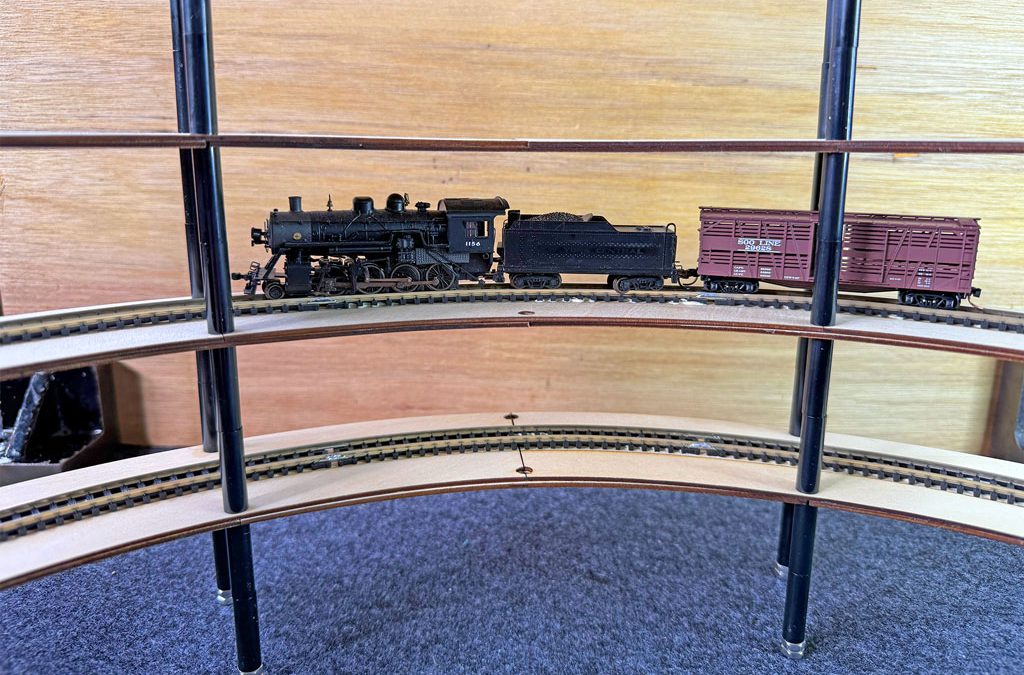
I designed this Model Railroad Helix Calculator to help design and build smooth, functional helix inclines for your layout. A helix is a spiral track configuration that allows a train to ascend or descend between different levels while minimizing the grade (slope) to avoid derailments or excessive strain on locomotives. To calculate a helix’s grade, you’ll need to know the desired clearance (vertical distance), the radius of the curve, and the track and base thickness. This calculator will help determine the number of turns, the grade percentage, bracing spacing, and the total track length needed. As a starting point. a gentle grade—usually under 2%—is ideal for reliable operation, though space constraints may require steeper inclines. Proper planning with this helix calculator should ensure smooth running and an impressive multi-level model railroad. Let me know if you’d like help working through your numbers!
Definitions & Notes
- The rise in a helix refers to the vertical distance the train climbs in one complete loop around the helix and is measured from the top of the lower rail to the top of the upper rail.
N-Scale
- NMRA Clearance Gauge Height 1.6″
- Atlas Flex Track Height: 0.15″
- Standard Cork Height: 0.11″
- Kato Track & Base Height: 0.275
HO-Scale
- NMRA Clearance Gauge Height 3.0″
- Atlas Flex Track Height: 0.20″
- Standard Cork Height: 0.18″
- Kato Track & Base Height: 0.39
Conversions
- 1/8″ (0.125)
- 3/16″ (0.188)
- 1/4″ (0.25)
- 3/8″ (0.375)
- 1/2″ (0.50)
- Desired Clearance: This is the distance from the top of the rial up to the bottom of the next ramp.
- Track Thickness: This is the thickness of the track and any sub-roadbase, like plastic, cork, or foam.
- Ring Thickness: This is the total material thickness of the helix rings, which are usually made of hardboard, plywood, or plastic.
- Curve Radius: This is the actual centerline radius of the track curve.



Chris,
The data you present near the end of this post under the HO scale column lists N scale descriptions.
HO-Scale
NMRA N-Scale Clearance Gauge Height 3.0″
Atlas N-Scale Flex Track Height: 0.20″
Standard N-Scale Cork Height: 0.18″
Kato N-Scale Track & Base Height: 0.39
You might want to edit those.
Fixed it! Thanks for pointing that out/